The Metric Advantage: Why Quantifying Your Resume Results is the Key to Landing Your Dream Job
Introduction: Why Most Résumés Fail to Capture Attention
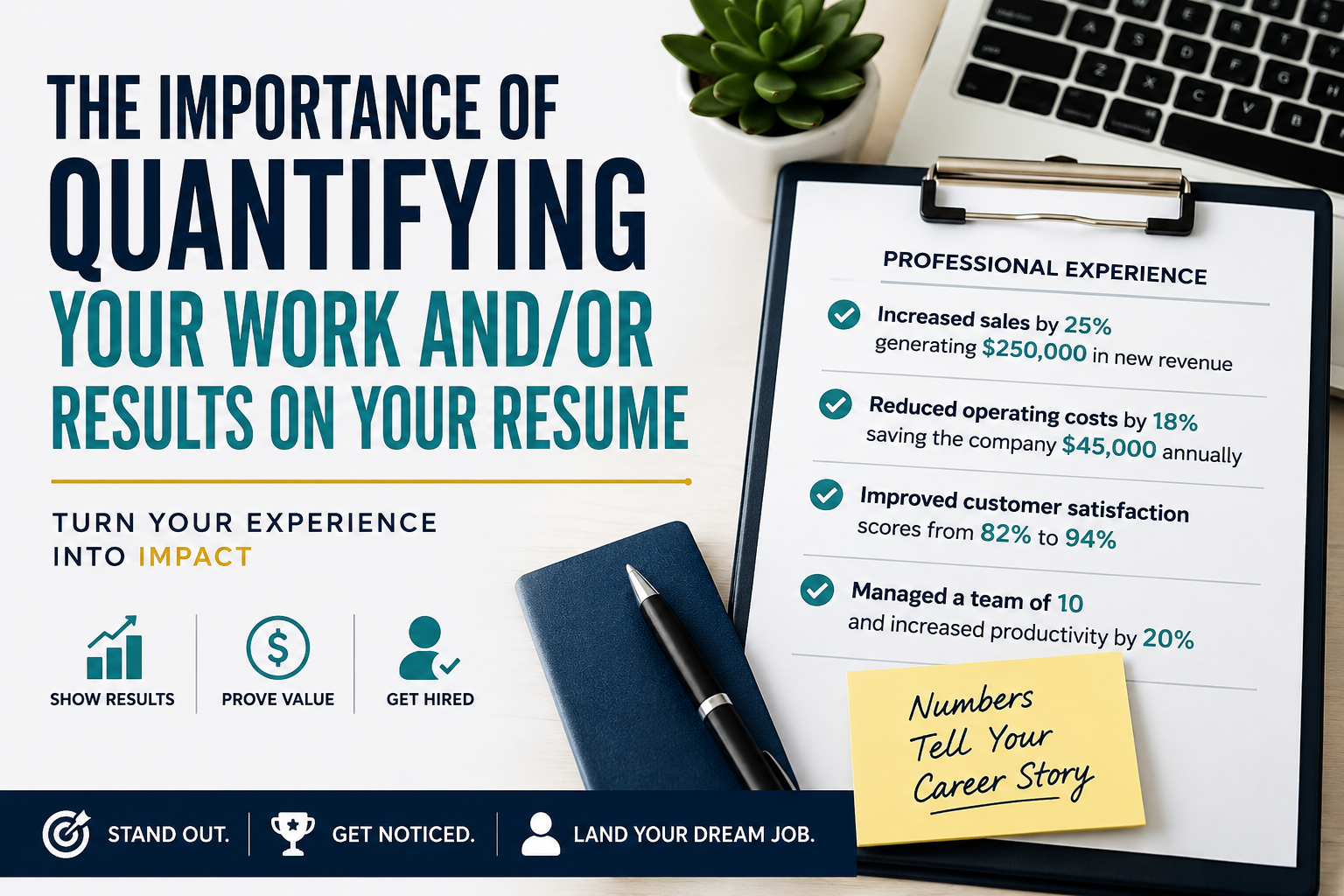
Most job seekers spend hours polishing their résumés, yet many continue to struggle with getting interviews. They update formatting, tweak wording, and add new skills, but overlook one of the most important elements recruiters look for: measurable results.
The reality is that employers are not hiring job descriptions. They are hiring outcomes. When a hiring manager reviews your résumé, they ask one fundamental question:
“What value will this candidate bring to our organization?”
Unfortunately, many résumés fail to answer that question. Instead, they contain long lists of responsibilities that could apply to almost anyone in a similar position.
Consider these examples:
Résumé #1
- Answered customer inquiries
- Managed inventory
- Assisted with scheduling
- Trained employees
Résumé #2
- Resolved 75+ customer inquiries daily while maintaining a 97% satisfaction rating
- Managed inventory valued at over $500,000 with 99% accuracy
- Coordinated scheduling for 25 employees across three departments
- Trained 15 new employees, reducing onboarding time by 30%
Which candidate appears more valuable? The second résumé instantly communicates impact, performance, and results.
This is the power of quantification.
Throughout this guide, you’ll learn how to identify, calculate, and communicate your accomplishments in ways that attract recruiters, impress hiring managers, and increase interview opportunities.
Why Numbers Matter: The Psychology of Recruitment
Recruiters spend surprisingly little time reviewing résumés during the initial screening process. Various recruiting studies have shown that résumé reviews are often measured in seconds rather than minutes. They are looking for a return on investment (ROI). They want to know: “If I hire this person, how will they add value to my bottom line?”
Numbers act as a universal language. When a candidate writes, “Managed a sales team,” it is vague.
When they write, “Led a team of 10 to exceed annual sales targets by 15%, generating an additional $250,000 in revenue,” it is a factual achievement.
Quantifying your work provides:
- Credibility: Numbers are harder to refute than adjectives.
- Scalability: They show the magnitude of your influence.
- Context: They help the recruiter understand the scope of your previous environments.
When a recruiter sees:
- 25% increase
- $1.2 million revenue
- Team of 15 employees
- 99% accuracy rate
- 40% reduction in processing time
They immediately gain insight into the scope and impact of your work.
Numbers create what psychologists call cognitive fluency. Information becomes easier to process, easier to compare, and easier to remember.
A statement such as:
“Improved operational efficiency”
requires interpretation.
A statement such as:
“Reduced processing time by 37%”
requires no interpretation. The result is immediate credibility.
Numbers Create Trust
Many candidates describe themselves as:
- Hardworking
- Results-oriented
- Detail-oriented
- Strong communicators
- Effective leaders
The problem is that everyone says these things. Quantifiable achievements provide evidence instead of claims.
For example, instead of: “Strong leadership skills”
Write:
“Led a team of 12 employees that exceeded productivity goals for six consecutive quarters.”
The second statement proves leadership rather than merely asserting it.
Numbers Tell a Business Story
Organizations exist to achieve goals.
Whether you work in healthcare, administration, sales, education, customer service, manufacturing, or technology, your employer measures success in some way.
By quantifying your accomplishments, you demonstrate that you understand how your work contributes to organizational objectives.
This business-minded perspective immediately elevates your professional brand.
Responsibilities vs. Accomplishments: The Critical Difference
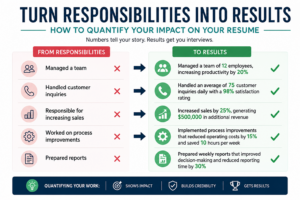 One of the biggest résumé mistakes is confusing responsibilities with achievements.
- Responsibilities describe what your employer expected you to do.
- Achievements describe the results you delivered.
Responsibility-Based Résumé Statement
“Responsible for managing social media accounts.”
Achievement-Based Résumé Statement
“Managed social media accounts that increased audience engagement by 62% and generated 1,500 new followers within six months.”
Notice the difference. The first statement explains the job. The second statement demonstrates performance. Hiring managers already know what someone in your position was supposed to do.
What they want to know is whether you did it exceptionally well.
Why Accomplishments Win
Accomplishment-focused résumés:
- Differentiate candidates
- Demonstrate value
- Support interview discussions
- Increase recruiter engagement
- Improve professional credibility
Every bullet point on your résumé should answer one question:
“What measurable impact did I make?”
 The Formula for High-Impact Résumé Bullet Points
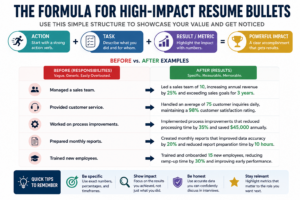
One of the easiest ways to improve your résumé is by using a structured accomplishment formula.
Action + Task + Result
This formula transforms weak statements into powerful career achievements.
Example
Weak:
“Handled customer complaints.”
Strong:
“Resolved customer complaints through proactive communication strategies, reducing escalation rates by 35%.”
Let’s break it down:
- Action: Resolved
- Task: Customer complaints
- Result: Reduced escalation rates by 35%
The result is a statement that demonstrates both responsibility and impact.
Additional Examples
Weak:
“Managed company scheduling.”
Strong:
“Managed scheduling for 40 employees across multiple departments, reducing scheduling conflicts by 50%.”
Weak:
“Prepared monthly reports.”
Strong:
“Prepared monthly performance reports that improved executive decision-making and reduced reporting preparation time by 20%.”
The formula works across virtually every profession and career level.
How to Extract Metrics from Your Career History
Many professionals believe they don’t have measurable achievements because they weren’t in sales or finance. Every position generates metrics. The key is learning where to look.
Financial Metrics
Financial metrics are among the most persuasive because they directly impact the organization’s bottom line.
Examples include:
- Revenue generated
- Revenue influenced
- Budget responsibility
- Cost reductions
- Expense management
- Contract value
- Profit improvement
Examples:
- Increased territory revenue by 18%
- Managed a $750,000 annual budget
- Reduced vendor expenses by $45,000 annually
- Negotiated contracts totaling $1.2 million
Even if you weren’t directly responsible for revenue generation, you likely influenced financial outcomes through efficiency improvements or cost management.
Efficiency Metrics
Efficiency metrics demonstrate operational improvement. Employers value candidates who can help organizations do more with fewer resources.
Examples:
- Time savings
- Process improvements
- Productivity increases
- Automation implementation
- Workflow enhancements
Examples:
- Reduced invoice processing time by 60%
- Automated weekly reporting, saving 8 hours per week
- Improved project completion timelines by 25%
- Increased department productivity by 18%
Quality Metrics
Quality metrics demonstrate attention to detail and operational excellence.
Examples:
- Error reduction
- Accuracy improvements
- Compliance rates
- Quality control metrics
Examples:
- Maintained 99.8% inventory accuracy
- Reduced documentation errors by 42%
- Achieved 100% compliance during regulatory audits
- Improved product quality scores by 15%
Customer Metrics
Customer-focused metrics are valuable across many industries.
Examples:
- Customer satisfaction
- Retention rates
- Resolution rates
- Customer growth
Examples:
- Maintained a 98% customer satisfaction rating
- Increased customer retention by 20%
- Reduced customer complaints by 35%
- Improved first-contact resolution rates by 25%
Leadership Metrics
Leadership impact can often be quantified through team performance.
Examples:
- Team size
- Employee retention
- Productivity improvements
- Training outcomes
Examples:
- Led a team of 18 employees
- Reduced turnover by 22%
- Improved team productivity by 15%
- Trained 30 new hires annually
The Power of Quantitative Data in ATS Screening
Applicant Tracking Systems have become a standard part of modern hiring. While ATS software primarily searches for keywords, quantified achievements play a critical role once your résumé reaches human review. Numbers naturally draw attention. A recruiter reviewing dozens or hundreds of résumés is more likely to notice:
- Increased revenue by 28%
- Reduced costs by $50,000
- Managed 120 client accounts
- Led a team of 15 employees
…than generic statements lacking measurable results. Quantification also demonstrates professional maturity. Candidates who track performance tend to be viewed as more results-oriented and business-focused. As a result, quantified résumés often perform better during both ATS screening and recruiter evaluation.
Quantifying your accomplishments is only one part of creating an effective résumé. Equally important is ensuring your resume is optimized for Applicant Tracking Systems (ATS) and recruiter searches. If you’re struggling to get interviews despite having strong experience, our Ultimate Job Search Toolkit can help to improve your chances of making it through initial screenings.
Industry-Specific Résumé Metrics Library
Administrative Professionals
- Scheduled 150+ monthly meetings
- Managed calendars for five executives
- Reduced filing errors by 30%
- Improved document retrieval time by 40%
Human Resources
- Recruited 75 employees annually
- Reduced time-to-fill positions by 25%
- Increased employee retention by 18%
- Managed benefits administration for 500 employees
Marketing
- Increased website traffic by 65%
- Improved email open rates by 28%
- Reduced customer acquisition costs by 15%
- Generated 1,200 qualified leads annually
Sales
- Exceeded quota by 130%
- Generated $2 million in annual revenue
- Increased client retention by 20%
- Closed 45 new accounts
Information Technology
- Reduced system downtime by 50%
- Supported 2,000 end users
- Completed migration projects ahead of schedule
- Reduced cybersecurity incidents by 35%
Customer Service
- Assisted 80 customers daily
- Maintained a 97% satisfaction score
- Reduced complaint volume by 25%
- Achieved a 95% first-call resolution rate
Addressing the Challenges: What if You Don’t Have Data?
One of the most common concerns job seekers have is:
“I don’t know my numbers.”
Don’t let that stop you. You can still build a powerful résumé.
Use Conservative Estimates
Think about your typical workload.
Examples:
- Average customers served daily
- Average projects completed monthly
- Average team size supported
Estimated metrics are acceptable when based on reasonable professional judgment.
Use Scope Metrics
Scope alone provides valuable context.
Examples:
- Managed a team of 10
- Supported 500 customers
- Coordinated operations across three locations
- Maintained records for 2,000 clients
Use Comparative Results
Examples:
- Reduced processing time significantly
- Improved response speed compared to previous methods
- Increased efficiency relative to prior workflows
The goal is to provide measurable context whenever possible.
Using Résumé Metrics During Interviews
One overlooked advantage of quantified résumés is interview preparation. Every metric on your résumé becomes a potential interview story. When an interviewer asks:
“Tell me about a time you improved a process.”
You already have an answer. Use the STAR Method:
Situation – Describe the challenge.
Task – Explain your responsibility.
Action – Describe what you did.
Result – Share the measurable outcome.
For example:
Situation: Customer complaints were increasing.
Task: Improve customer satisfaction.
Action: Implemented a new communication process.
Result: Reduced complaints by 35% within six months.
The stronger your metrics, the stronger your interview stories become.
The metrics you include on your résumé can become powerful examples during interviews. Learning how to communicate those accomplishments effectively is just as important as documenting them. For additional strategies, explore our Workplace Communication and Professional Confidence, where you’ll learn how to discuss achievements with clarity and confidence.
Résumé Transformation Clinic: Before and After Examples
Example 1
Before:
“Managed inventory.”
After:
“Managed inventory valued at $750,000 while maintaining 99% accuracy and reducing stock shortages by 20%.”
Example 2
Before:
“Assisted customers.”
After:
“Assisted 70+ customers daily while maintaining a 98% satisfaction rating.”
Example 3
Before:
“Handled scheduling.”
After:
“Coordinated scheduling for 40 employees across multiple shifts, reducing scheduling conflicts by 50%.”
Example 4
Before:
“Trained new employees.”
After:
“Trained 25 new employees annually, reducing onboarding time by 30%.”
Example 5
Before:
“Created reports.”
After:
“Developed executive reporting dashboards that reduced reporting preparation time by 40%.”
Common Résumé Quantification Mistakes to Avoid
Inflating Numbers
Never exaggerate results. Employers may verify achievements during interviews or background checks.
Using Too Many Metrics
Not every sentence requires three numbers. Focus on the most meaningful accomplishments.
Ignoring Context
Always explain why a metric matters.
Instead of:
“Managed $100,000.”
Write:
“Managed a $100,000 departmental budget supporting operations for 25 employees.”
Focusing Only on Activity
Activity does not equal impact. Employers care about outcomes. Always connect your actions to measurable business results.
Final Thoughts: Numbers Turn Experience into Evidence
The difference between an average résumé and a high-performing résumé often comes down to one thing: evidence.
Anyone can list responsibilities. Successful candidates demonstrate results. By quantifying your work, you provide hiring managers with clear proof of your contributions, value, and professional impact.
Numbers make your accomplishments memorable.
They improve ATS performance.
They strengthen interview stories.
Most importantly, they help employers envision the value you can bring to their organization.
The next time you update your résumé, challenge yourself to replace every generic responsibility with a measurable accomplishment.
Because employers don’t hire tasks.
They hire results.
How to Calculate ROI on Your Job Performance
One of the most valuable mindset shifts a job seeker can make is learning to think like a business owner. Every organization hires employees because they expect a return on investment (ROI). In simple terms, employers invest money in salaries, benefits, training, equipment, and resources with the expectation that employees will generate value that exceeds those costs.
When you understand this concept, it becomes much easier to identify and communicate the results you should highlight on your resume.
What Is ROI in the Workplace?
Return on Investment (ROI) measures the value created compared to the resources invested. While you may not always have access to exact financial data, you can still identify ways your work generated value.
For example:
- Did you save time?
- Did you reduce errors?
- Did you increase sales?
- Did you improve customer satisfaction?
- Did you streamline a process?
- Did you reduce turnover?
- Did you improve productivity?
All of these outcomes have business value. Employers care about results because results impact profitability, efficiency, customer retention, employee engagement, and growth.
The Four Ways Employees Create ROI
1. Generate Revenue
This is the most obvious form of ROI.
Examples include:
- Closing sales
- Acquiring new clients
- Expanding customer accounts
- Increasing contract values
Resume Example:
“Generated $850,000 in annual revenue while exceeding sales goals by 125%.”
2. Reduce Costs
Saving money is often just as valuable as generating revenue.
Examples include:
- Negotiating vendor contracts
- Reducing waste
- Improving resource utilization
- Eliminating unnecessary expenses
Résumé Example:
“Negotiated supplier agreements that reduced annual operating expenses by $45,000.”
3. Save Time
Time is one of the most valuable resources within any organization. When employees create efficiencies, they increase organizational capacity.
Examples include:
- Automating reports
- Streamlining workflows
- Improving scheduling systems
- Reducing processing delays
Resume Example:
“Automated weekly reporting processes, saving approximately 10 labor hours per week.”
4. Reduce Risk
Organizations spend significant resources managing risk.
Examples include:
- Compliance improvements
- Safety enhancements
- Error reduction
- Quality control initiatives
Résumé Example:
“Implemented quality assurance procedures that reduced documentation errors by 40%.”
Simple ROI Calculations You Can Use
You do not need an MBA to estimate business impact. Here are a few practical calculations:
Time Savings Formula
Hours Saved Per Week × Hourly Cost × 52 Weeks
Example:
10 Hours Saved × $25 Hourly Cost × 52 Weeks
Annual Value = $13,000
Résumé Statement:
“Implemented workflow improvements that saved approximately $13,000 annually in labor costs.”
Cost Reduction Formula
Original Cost − New Cost = Savings
Example:
$100,000 Annual Expense − $80,000 Annual Expense
Annual Savings = $20,000
Résumé Statement:
“Reduced departmental expenses by $20,000 annually through vendor contract renegotiations.”
Revenue Growth Formula
(New Revenue − Previous Revenue) ÷ Previous Revenue × 100
Example:
$500,000 Revenue to $650,000 Revenue
Growth = 30%
Résumé Statement:
“Increased territory revenue by 30% within one fiscal year.”
Thinking Beyond Job Duties
Most employees focus on tasks. High-performing professionals focus on outcomes. Instead of asking:
“What was my job?”
Ask:
“What changed because of my work?”
The answer often reveals the metrics that belong on your résumé. Perhaps customer satisfaction improved. Perhaps project completion accelerated. Perhaps costs decreased. Perhaps sales increased.
Those are the results employers want to see. The more clearly you can demonstrate ROI, the more compelling your resume becomes.
50 Resume Metrics Examples by Industry and Job Function
If you’re struggling to identify measurable accomplishments, use the examples below as inspiration.
Administrative and Office Support
- Scheduled 200+ meetings annually.
- Managed calendars for 5 executives.
- Reduced filing retrieval time by 40%.
- Maintained records with 99% accuracy.
- Coordinated travel arrangements for 50+ business trips annually.
Customer Service
- Assisted 80+ customers daily.
- Maintained a 97% customer satisfaction rating.
- Reduced complaint escalation rates by 30%.
- Achieved a 95% first-contact resolution rate.
- Improved customer retention by 15%.
Human Resources
- Recruited 75 employees annually.
- Reduced time-to-fill positions by 25%.
- Improved employee retention by 18%.
- Managed benefits administration for 500 employees.
- Conducted onboarding for 100+ new hires annually.
Marketing
- Increased website traffic by 65%.
- Improved email open rates by 28%.
- Generated 1,200 qualified leads annually.
- Increased social media engagement by 75%.
- Reduced customer acquisition costs by 20%.
Sales
- Generated $2 million in annual revenue.
- Exceeded quota by 130%.
- Closed 45 new client accounts.
- Increased account retention by 25%.
- Grew territory sales by 18%.
Information Technology
- Reduced system downtime by 50%.
- Supported 2,500 end users.
- Improved system response times by 35%.
- Reduced cybersecurity incidents by 40%.
- Completed software deployments ahead of schedule.
Accounting and Finance
- Managed budgets exceeding $5 million.
- Reduced reconciliation errors by 25%.
- Improved invoice processing speed by 30%.
- Reduced outstanding receivables by 20%.
- Maintained 99.9% financial reporting accuracy.
Healthcare
- Provided care for 25 patients daily.
- Reduced patient wait times by 20%.
- Maintained 100% compliance with regulatory standards.
- Trained 15 new healthcare employees.
- Improved patient satisfaction scores by 18%.
Education
- Improved student test scores by 15%.
- Increased parent participation by 40%.
- Managed classrooms of 30 students.
- Developed curriculum used across 5 grade levels.
- Mentored 100+ students annually.
Operations and Manufacturing
- Increased production output by 22%.
- Reduced downtime by 35%.
- Improved inventory accuracy to 99%.
- Reduced workplace incidents by 25%.
- Saved $75,000 annually through process improvements.
How to Use These Examples
Do not copy these examples word-for-word. Instead, use them to identify similar accomplishments in your own experience.
Ask yourself:
- Did I improve something?
- Did I save time?
- Did I save money?
- Did I increase efficiency?
- Did I support growth?
- Did I improve quality?
The answers often lead directly to powerful resume metrics.
The 10-Minute Resume Metric Audit Checklist
Before submitting your résumé, conduct this simple 10-minute audit to ensure every section communicates measurable value.
Step 1: Review Every Bullet Point
Read each bullet individually.
Ask:
“Does this describe a responsibility or a result?”
If it only describes a task, revise it to include an outcome.
Example
Before:
“Managed customer accounts.”
After:
“Managed 150 customer accounts while maintaining a 96% retention rate.”
Step 2: Search for Missing Numbers
Look for opportunities to add:
- Percentages
- Dollar amounts
- Time savings
- Team sizes
- Customer volumes
- Project values
If a bullet contains no measurable information, consider whether a metric can be added.
Step 3: Identify Business Impact
For each accomplishment, determine which business objective it supported:
- Revenue growth
- Cost reduction
- Efficiency improvement
- Customer satisfaction
- Risk reduction
- Quality enhancement
The stronger the business impact, the stronger the resume statement.
Step 4: Replace Weak Action Verbs
Eliminate passive language.
Avoid:
- Helped
- Assisted
- Worked on
- Participated in
Use stronger alternatives:
- Led
- Implemented
- Improved
- Increased
- Reduced
- Streamlined
- Developed
- Optimized
Strong verbs create stronger impressions.
Step 5: Add Context
Numbers alone aren’t enough. Context matters.
Instead of:
“Managed $100,000.”
Write:
“Managed a $100,000 departmental budget supporting operations for 20 employees.”
Context helps recruiters understand scale.
Step 6: Check for Balance
Don’t overload every bullet with excessive metrics. Focus on quality over quantity. Your strongest accomplishments should receive the most attention.
Step 7: Verify Accuracy
Never exaggerate. Ask yourself:
“Can I confidently discuss this metric in an interview?”
If the answer is no, revise it. Credibility is essential.
Step 8: Prioritize Recent Accomplishments
Your most recent positions should contain the strongest and most detailed metrics. Recruiters care most about your current capabilities.
Step 9: Highlight Career Progression
Metrics can demonstrate growth.
Examples:
- Increased sales responsibility
- Larger teams managed
- Bigger budgets controlled
- Expanded geographic coverage
Growth tells employers that your value has increased over time.
Step 10: Conduct the Final Test
Review your résumé and ask:
“If a hiring manager spent six seconds reviewing this document, would they immediately understand my value?”
If your résumé clearly communicates measurable results, the answer should be yes.
Final Resume Metric Audit Summary
Before submitting your résumé, ensure you can answer “yes” to the following questions:
✓ Have I included measurable accomplishments?
✓ Have I quantified my impact whenever possible?
✓ Have I demonstrated business value?
✓ Have I used strong action verbs?
✓ Have I included context and scale?
✓ Are my numbers accurate and defensible?
✓ Do my accomplishments distinguish me from other candidates?
If so, your résumé is significantly more likely to capture attention, pass recruiter screening, and generate interviews.
Remember: employers don’t hire responsibilities. They hire professionals who can deliver measurable results. Your résumé should make that value impossible to miss.