The Complete Guide to Documenting Workplace Issues: A Strategic Framework for Professional Resolution
In the modern professional landscape, the ability to effectively document workplace issues is not merely a defensive tactic; it is an essential skill for career longevity, legal protection, and personal well-being. Whether an employee is facing harassment, systemic bias, performance management disputes, or safety concerns, the quality of their documentation often determines the outcome of any formal investigation or resolution process.
Many professionals underestimate the importance of contemporaneous record-keeping until they are already in the midst of a crisis. This guide provides a comprehensive framework for documenting workplace issues with precision, objectivity, and strategic intent.
Common Workplace Issues That Require Documentation
 Many employees assume documentation is only necessary when they are considering legal action. Documenting workplace issues can help resolve concerns long before they escalate into formal complaints or employment disputes.
Situations that warrant documentation include:
Workplace Harassment
Harassment can be verbal, physical, visual, or digital. Employees should document:
- Inappropriate comments
- Offensive jokes
- Repeated unwanted contact
- Intimidation tactics
- Harassing emails or messages
- Retaliatory behavior
A single incident may seem insignificant in isolation. However, detailed records often reveal patterns that demonstrate persistent misconduct.
Discrimination
Documentation is particularly important when an employee believes they are being treated differently because of a protected characteristic.
Examples include:
- Unequal disciplinary actions
- Promotion denials
- Hiring decisions
- Exclusion from opportunities
- Pay disparities
- Unequal workload assignments
When documenting discrimination concerns, focus on objective observations and measurable differences in treatment.
Retaliation
Retaliation occurs when an employee experiences adverse treatment after engaging in a protected activity such as:
- Reporting harassment
- Filing an HR complaint
- Participating in an investigation
- Requesting accommodation
- Reporting safety concerns
Employees should carefully document any negative changes that occur after a protected activity.
Workplace Bullying
While bullying may not always meet the legal definition of harassment, it can significantly impact employee well-being and productivity.
Document:
- Public humiliation
- Persistent criticism
- Exclusion from meetings
- Unreasonable deadlines
- Hostile communication patterns
Safety Concerns
Safety issues should always be documented immediately.
Examples include:
- Unsafe working conditions
- Equipment failures
- OSHA violations
- Unreported injuries
- Near-miss incidents
Safety documentation not only protects employees but can also prevent future accidents.
Recognizing Early Warning Signs of Workplace Problems
 One of the biggest mistakes employees make is waiting until a situation becomes severe before they begin documenting it. By the time a formal complaint becomes necessary, important details may have been forgotten, deleted, or dismissed as isolated incidents.
Many workplace issues begin subtly. What starts as a minor communication problem can gradually develop into a pattern of exclusion, retaliation, harassment, or discrimination. Recognizing these early warning signs allows employees to begin documenting concerns before the situation escalates.
Common warning signs include:
- Sudden changes in management behavior
- Exclusion from meetings or communications
- Unexplained negative performance feedback
- Unequal workload assignments
- Inconsistent enforcement of workplace policies
- Hostile or dismissive communication
- Repeated cancellation of one-on-one meetings
- Being denied opportunities routinely provided to peers
Employees often second-guess themselves when these issues first appear. They may wonder whether they are overreacting or misinterpreting a situation. Documentation removes uncertainty by allowing facts to speak for themselves.
For example, a single missed meeting invitation may be accidental. However, documentation may reveal that an employee was excluded from six project meetings over two months while others in similar roles were consistently included. Patterns are often easier to identify when events are documented as they occur rather than reconstructed from memory later.
Another benefit of early documentation is that it encourages proactive problem-solving. Employees can address concerns sooner, before relationships deteriorate or workplace conflicts become entrenched. Documentation is not about expecting the worst from coworkers or managers. It is about maintaining an accurate record of professional interactions so that facts remain available if questions arise later.
The Philosophy of Professional Documentation
Documentation serves as the “source of truth” in any professional conflict. When organizations address grievances, memory is often considered unreliable—subjective, fading, and prone to emotional bias. Written records, however, provide a tangible timeline that shifts the focus from “he-said, she-said” narratives to verifiable facts. Effective documentation is not about keeping a grievance diary; it is about creating a factual trail that demonstrates patterns of behavior, organizational impact, and the professional steps taken to resolve the issue.
The Foundation: What to Record
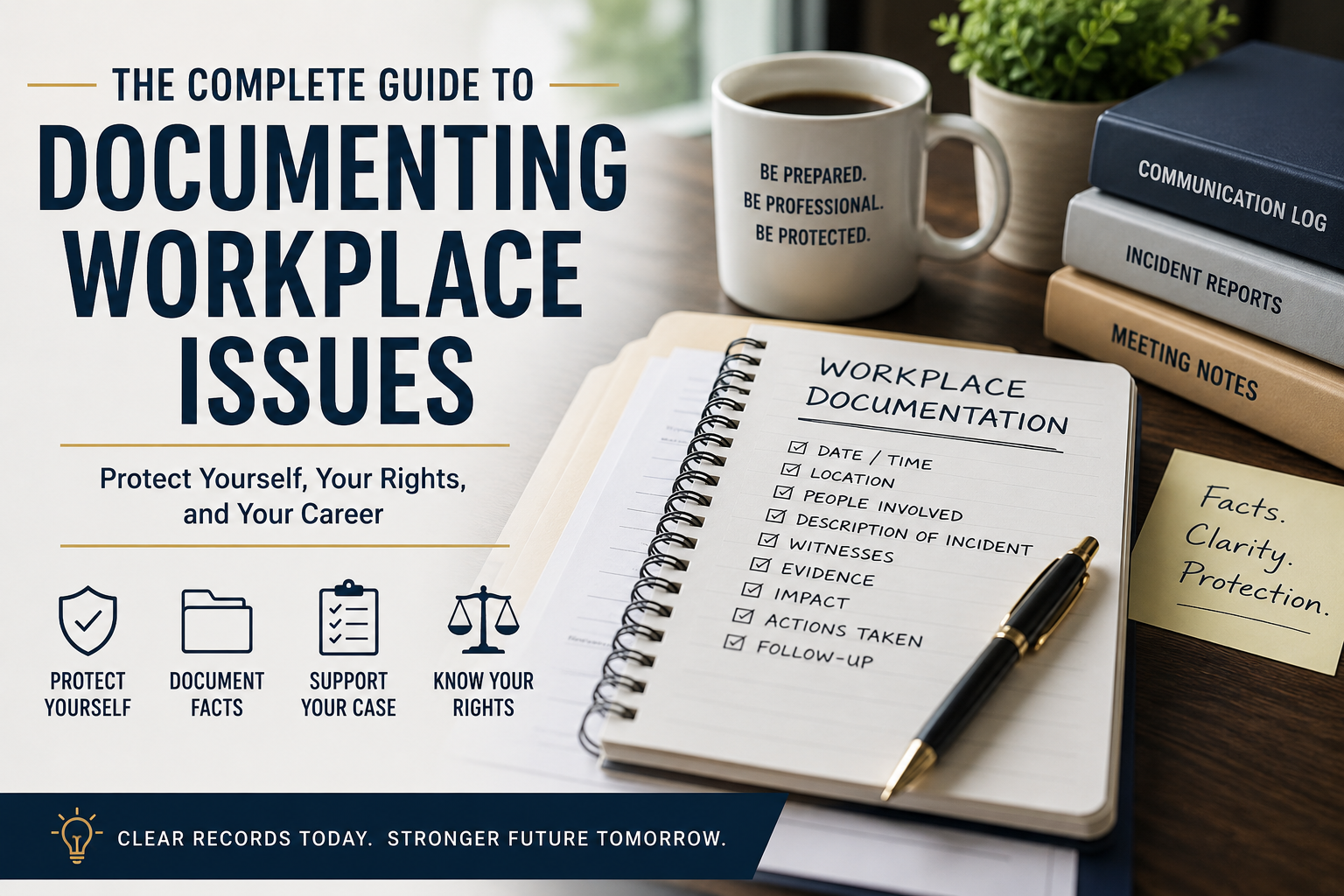
To build a robust case, an employee must understand what constitutes relevant evidence. Documentation should go beyond a list of complaints; it must include context, impact, and proof.
The “Who, What, Where, When, and Why” Framework:
The Parties Involved: Document the names and titles of everyone present during an incident or involved in the issue. Include peripheral witnesses who may have observed interactions.
Specifics of the Incident: Record the date, exact time, and precise location. Vague entries like “Tuesday, late afternoon” are insufficient. Use “Tuesday, October 14th, at 3:45 PM in the North conference room.”
The Narrative: Describe the event in clinical, objective language. Avoid emotive adjectives. Instead of stating, “My manager was aggressive and mean,” write, “My manager raised their voice, stood over my desk, and used derogatory language regarding my recent project report.”
The Impact: Clearly state how the issue affects your work, your health, or the team’s productivity. Is this interfering with deadlines? Is it creating a hostile environment that prevents you from performing core duties?
Evidence and Artifacts: Emails, instant message logs (Slack/Teams), meeting minutes, performance reviews, and calendar invitations act as the “corroborating backbone” of your documentation. Save these externally; never rely on company servers alone, as access can be revoked instantaneously.
The Anatomy of an Effective Incident Report
One of the most common mistakes employees make is writing vague notes that lack detail. A strong incident report should include:
Date and Time: Document the exact date and time whenever possible.
Instead of: “Last week sometime”
Write: “Wednesday, March 12, 2026, at approximately 2:17 PM”
Location: Identify where the incident occurred.
Examples:
- Conference Room B
- Manufacturing Floor
- Microsoft Teams Meeting
- Email Thread
- Company Parking Lot
Individuals Present: List everyone involved, including witnesses.
Include:
- Full names
- Job titles
- Departments
Objective Description: Focus on observable behavior.
Avoid: “My manager was rude.”
Instead, write: “My manager stated, ‘Your work is always a problem,’ in front of five team members.”
Business Impact: Explain how the incident affected:
- Productivity
- Team morale
- Project outcomes
- Deadlines
- Employee engagement
Decision-makers are more likely to act when they understand the organizational consequences.
Workplace Documentation Templates: Many professionals struggle because they do not know how to structure their records. A simple template can improve consistency.
Incident Documentation Template
Date:
Time:
Location:
Individuals Present:
Description of Incident:
(Provide factual details.)
Witnesses:
(List anyone who observed the event.)
Evidence Available:
(Emails, messages, recordings where legally permitted, meeting notes.)
Impact on Work:
(Explain effects on performance, productivity, or well-being.)
Actions Taken:
(Document any conversations, reports, or follow-up steps.)
Outcome:
(Record any response received.)
Using a standardized format makes your documentation easier to review and understand.
Featured Resource: Workplace Documentation & Protection Toolkit
Many professionals start documenting workplace issues with good intentions but struggle to stay organized and consistent over time. While the templates in this guide provide a solid foundation, maintaining thorough records often requires a structured system.
The Workplace Documentation & Protection Toolkit was designed to help professionals create clear, organized, and defensible workplace records. The toolkit includes daily work logs, incident documentation forms, communication tracking logs, decision trackers, performance and feedback trackers, concern and pattern tracking systems, and professional email templates. It provides a repeatable framework for documenting workplace interactions, tracking commitments, identifying recurring issues, and maintaining a professional record you can rely on when important conversations arise.
The toolkit is especially valuable for:
- Employees navigating difficult workplace situations
- Professionals managing performance discussions
- Individuals documenting workplace concerns or conflicts
- Anyone who wants a clear record of accomplishments, decisions, and communications
- Employees seeking greater confidence in conversations with leadership or Human Resources
Rather than relying on memory alone, a structured documentation system allows you to maintain factual, consistent records that can support professional discussions, internal investigations, performance reviews, and career advancement opportunities.
Recommended Next Step: Download the Workplace Documentation & Protection Toolkit and begin documenting important workplace interactions before problems arise. Consistent documentation is most effective when it becomes a professional habit rather than a reaction to a crisis.
The Methodology: How to Record Effectively
The efficacy of documentation lies in its consistency and objectivity.
Contemporaneous Recording: The most powerful evidence is recorded at or near the time of the incident. Courts and HR departments place a higher value on journals written in real-time than on retrospective summaries written months later, which may be perceived as “reconstructed” for legal gain.
Objective Tone: Professional documentation must remain detached. By stripping away personal frustration and focusing on the behavior, the writer maintains credibility. If the document reads like a rant, it will be dismissed as subjective. If it reads like a police report—logical, chronological, and precise—it is far more difficult to challenge.
The “Pattern” Approach: Isolated incidents are often dismissed as “personality clashes” or “bad days.” Documentation is most effective when it reveals a pattern. By numbering entries and linking them to company policy or the employee handbook, you demonstrate that the issue is not a one-off grievance but a persistent trend violating corporate conduct standards.
Digital Documentation Best Practices
Modern workplace conflicts increasingly occur through digital communication channels.
Employees should understand how to preserve digital evidence responsibly.
Emails
Save relevant emails in multiple locations.
Create folders for:
- Performance discussions
- HR communications
- Workplace concerns
- Follow-up actions
Instant Messaging Platforms
Platforms such as:
- Microsoft Teams
- Slack
- Google Chat
often contain critical evidence.
Capture:
- Screenshots
- Conversation exports when permitted
- Time-stamped messages
Virtual Meetings
After important meetings, send a follow-up email summarizing key points discussed.
Example: “Thank you for meeting me today. My understanding is that we agreed to…”
These summaries create valuable documentation and reduce misunderstandings.
How to Document Difficult Conversations with Managers
 Many workplace concerns begin with conversations that seem insignificant at the time. A manager may make a verbal promise, provide unclear instructions, or offer feedback that later becomes a point of disagreement. Without documentation, these conversations often become a matter of conflicting memories.
Whenever an important discussion occurs, create a record as soon as possible. This does not mean secretly recording conversations or creating a transcript. Instead, document key facts while they are fresh in your mind.
Consider recording:
- The date and time of the conversation
- The individuals present
- Topics discussed
- Commitments made
- Expectations communicated
- Any deadlines established
- Follow-up actions agreed upon
One of the most effective strategies is sending a professional follow-up email.
For example: “Thank you for meeting me today. My understanding is that the project deadline has been extended to June 15 and that I will provide a revised status update next Friday. Please let me know if I have misunderstood any part of our discussion.”
This type of communication serves several purposes. It confirms expectations, prevents misunderstandings, and creates a written record that can be referenced later if questions arise.
Documenting difficult conversations is particularly important when discussing:
- Performance concerns
- Workload issues
- Accommodation requests
- Promotion opportunities
- Disciplinary actions
- Workplace conflicts
- Changes in responsibilities
Professional documentation helps ensure accountability on all sides and creates a shared understanding of expectations.
Understanding the Strategic Purpose
Why do we document? The answer varies depending on the professional’s goals. For some, it is to facilitate an internal resolution through HR. For others, it is to build a foundation for an exit strategy or potential litigation.
For Internal Resolution: When the goal is to resolve an issue within the company, documentation serves as a roadmap for HR. It allows the HR business partner to see exactly where the breakdown occurred and identifies the specific policies that were breached. It facilitates quicker investigation, as you have effectively done the “legwork” for them.
For Legal Protection: If a workplace issue evolves into a legal matter (such as constructive discharge, wrongful termination, or discrimination), your documentation becomes discovery evidence. In these instances, the “paper trail” proves that you attempted to report the issue through proper channels and that the organization failed to take corrective action, which is often a key requirement for proving liability.
The Role of HR in Workplace Documentation
Many employees misunderstand the role of Human Resources. HR is responsible for:
- Investigating complaints
- Ensuring policy compliance
- Reducing organizational risk
- Maintaining workplace standards
HR is not automatically an employee advocate or a management advocate. Documentation helps HR evaluate facts objectively. When presenting concerns to HR:
Be Organized: Create a chronological timeline.
Provide Supporting Evidence
Include:
- Emails
- Screenshots
- Meeting notes
- Performance reviews
Focus on Facts: Avoid assumptions regarding motives.
For example: Avoid: “My manager hates me.”
Instead: “On three separate occasions, I was excluded from project meetings despite being listed as the project lead.”
This distinction significantly increases credibility.
Once you’ve gathered your documentation, writing a professional complaint can be the next challenge. These Complaint Letter Templates That Get Results can help you communicate workplace concerns clearly and professionally.
What Happens After You Submit Documentation to HR?
 Many employees hesitate to report workplace concerns because they are unsure what will happen after they submit documentation. Understanding the investigation process can help reduce anxiety and improve expectations.
Every organization handles complaints differently, but most investigations follow a similar process.
Step 1: Initial Review
Once documentation is submitted, HR typically reviews the materials to determine:
- Whether company policies may have been violated
- Whether additional information is needed
- Whether immediate action is required
The quality of your documentation can significantly influence this stage. Organized, chronological records help investigators understand the situation more quickly.
Step 2: Fact Gathering
HR may interview:
- The reporting employee
- The accused individual
- Witnesses
- Supervisors
- Relevant stakeholders
Documentation serves as a roadmap during these conversations. Rather than relying solely on memory, investigators can reference specific dates, events, and communications identified in the records.
Step 3: Evidence Review
Investigators may examine:
- Email correspondence
- Instant messages
- Meeting notes
- Performance reviews
- Security records
- Policy documents
This stage focuses on corroborating facts and identifying inconsistencies.
Step 4: Findings and Recommendations
After reviewing available evidence, HR may determine that:
- A policy violation occurred
- A misunderstanding occurred
- Additional investigation is required
- Insufficient evidence exists to support a finding
The outcome may include coaching, training, disciplinary action, mediation, policy changes, or other corrective measures.
Step 5: Follow-Up
Employees often assume the process ends after the investigation. In reality, follow-up documentation remains important.
Continue recording:
- New incidents
- Retaliatory behavior
- Management responses
- Resolution efforts
This ensures an ongoing record if problems persist after the investigation concludes. Understanding the process helps employees approach workplace concerns strategically rather than emotionally.
Building a Timeline That Tells the Complete Story
A single incident rarely explains the full picture. The most effective documentation often takes the form of a timeline.
Example:
January 5
Manager publicly criticized work product.
January 12
Employee requested clarification regarding expectations.
January 18
Manager declined meeting request.
February 2
Employee received first negative performance review despite positive prior reviews.
A timeline helps investigators identify:
- Patterns
- Escalation
- Repeated behavior
- Organizational response
Navigating the Risks of Documentation
While essential, documentation carries risks. Employees must be mindful of privacy and the proprietary nature of company information.
Avoid Sensitive Data: Never include trade secrets, PII (Personally Identifiable Information) of clients, or confidential company data in your personal notes. This can give the employer a legitimate reason to terminate your employment for a breach of confidentiality.
Maintain Security: Documentation must be private. If you are using a digital device, ensure it is encrypted and password-protected. If using a physical journal, keep it in a secure location at home, never in the office where it could be discovered or confiscated.
The “Paper Trail” Caution: Understand that if you initiate a formal complaint, the documentation you provide may be shared with the person you are reporting. You must be prepared for the fallout of a formal investigation.
Documentation Mistakes That Can Destroy Credibility
Even legitimate workplace concerns can be weakened by poor documentation practices.
Exaggeration: Never embellish events. If your documentation contains inaccuracies, decision-makers may question everything else.
Emotional Language: Avoid emotionally charged phrases.
Instead of: “This was outrageous.”
Use: “This behavior violated company policy regarding respectful workplace conduct.”
Delayed Documentation
Waiting months to record events can create credibility challenges. Document incidents as soon as possible.
Mixing Facts and Opinions
Separate observations from conclusions.
Facts: “The meeting invitation did not include my name.”
Opinion: “They excluded me intentionally.”
Document the fact first.
Final Best Practices: The Lifecycle of a Report
Once you have documented the issues, the final phase is execution.
Refine and Review: Before submitting your documentation, review it for clarity. Ask: “If a third party read this, would they understand the timeline and the issue without extra explanation?”
Reference Policy: Explicitly cite the employee handbook. For example: “This behavior contradicts Section 4.2 of the Employee Code of Conduct regarding Professional Integrity.”
Submit with Intent: When you present your documentation, do so with a clear, professional request for resolution. Express a desire to mend the working relationship or resolve the barrier to productivity.
If you’re unsure how to formally present your concerns, professionally written complaint letter templates can provide a helpful starting point.
Preserve the Records: Even after a resolution is reached, keep your records. Workplace dynamics can shift, and history often repeats itself. Having a consolidated file of past issues is a vital resource if the behavior resumes.
When Documentation May Be Needed for Legal Proceedings
 Most workplace concerns never become legal disputes. However, employees should understand situations where documentation may become particularly important.
Examples include:
- Wrongful termination claims
- Harassment complaints
- Discrimination cases
- Wage disputes
- Retaliation claims
- Whistleblower actions
- Disability accommodation disputes
In these situations, attorneys frequently evaluate:
- Dates
- Communications
- Witnesses
- Internal reporting efforts
- Organizational responses
A thorough paper trail often becomes one of the most valuable pieces of evidence available.
Using Documentation to Track Professional Accomplishments
While much of this guide focuses on documenting workplace concerns, documentation can also be one of the most powerful career development tools available.
Many professionals spend years accomplishing important work only to struggle when asked to summarize their contributions during performance reviews, promotion discussions, or job interviews.
Maintaining an accomplishment log allows employees to capture achievements as they occur rather than relying on memory months later.
Examples of accomplishments worth documenting include:
Project Successes
Track:
- Projects completed
- Deadlines met
- Budget savings achieved
- Process improvements implemented
- Customer satisfaction results
Recognition and Positive Feedback
Save:
- Thank-you emails
- Customer compliments
- Leadership recognition
- Performance awards
- Team acknowledgments
Professional Development
Document:
- Certifications earned
- Training completed
- New skills acquired
- Leadership opportunities
- Volunteer initiatives
Measurable Results
Whenever possible, quantify your impact.
Examples include:
- Reduced project costs by 15%
- Improved efficiency by 20%
- Completed project two weeks ahead of schedule
- Increased customer satisfaction scores
Keeping these records provides valuable evidence during:
- Performance evaluations
- Salary negotiations
- Promotion discussions
- Internal transfers
- Job searches
This is one reason the Workplace Documentation & Protection Toolkit can be valuable even for employees who are not currently experiencing workplace issues. Consistent documentation helps professionals preserve both accomplishments and concerns, creating a complete record of their career journey.
Documentation should not be viewed solely as protection against workplace problems. It should also be viewed as a strategic investment in long-term professional growth.
Creating a Culture of Professional Self-Advocacy
Workplace documentation should not be viewed as paranoia or distrust. Instead, it should be viewed as professional self-management.
High-performing professionals routinely document:
- Project decisions
- Performance achievements
- Meeting outcomes
- Career accomplishments
- Workplace concerns
Documentation creates clarity. Clarity reduces misunderstandings. Reduced misunderstandings lead to stronger professional relationships and better career outcomes. Employees who proactively manage their careers often combine workplace documentation with ongoing career development strategies to strengthen their professional reputation and advancement opportunities.
____________________________________________________________________________________
📝 Professional Resource: Workplace Documentation & Protection Toolkit
Stop relying on memory when workplace issues arise. The Workplace Documentation & Protection Toolkit provides professionally designed logs, trackers, documentation forms, and templates to help you organize workplace conversations, incidents, accomplishments, and concerns before they become major problems.
Included in the toolkit:
✔ Workplace incident documentation forms
✔ Communication tracking logs
✔ Performance and feedback trackers
✔ Concern and pattern tracking worksheets
✔ Professional workplace email templates
✔ Decision and action item trackers
👉 Get the Workplace Documentation & Protection Toolkit Here:
https://www.mindyeekhoff.com/product/1731/
___________________________________________________________________________________
The most successful employees understand that documentation is not about expecting conflict. It is about being prepared if conflict occurs.
Workplace Documentation Success Stories: Why Records Matter
The value of workplace documentation becomes clear when examining how it helps professionals navigate challenging situations. Consider the following examples.
Scenario 1: The Performance Review Dispute
An employee receives an unexpectedly negative performance review after years of positive feedback. Instead of relying on memory, the employee produces documentation that includes:
- Previous performance reviews
- Project completion records
- Positive client feedback
- Emails recognizing achievements
Because the employee maintained detailed records, leadership was able to identify inconsistencies and reassess the evaluation process.
Scenario 2: The Repeated Workplace Conflict
Two team members have ongoing disagreements that begin affecting project outcomes. One employee maintains a timeline documenting:
- Meeting discussions
- Assigned responsibilities
- Missed deadlines
- Follow-up communications
The documentation reveals a recurring communication breakdown rather than misconduct, allowing management to address the root cause and improve collaboration.
Scenario 3: The Harassment Investigation
An employee experiences repeated inappropriate comments over several months. Rather than submitting a general complaint, the employee provides:
- Dates and times
- Witness names
- Screenshots of messages
- Notes from conversations
The detailed records help investigators identify a pattern of behavior that might otherwise have been dismissed as isolated incidents.
Scenario 4: The Retaliation Concern
After reporting a workplace issue, an employee notices several changes:
- Removal from projects
- Exclusion from meetings
- Reduced responsibilities
Because the employee documented both the original complaint and subsequent actions, HR was able to evaluate whether retaliation concerns warranted further investigation.
The Common Thread
In each scenario, documentation provided clarity. The records did not create the facts. They preserved them. Organizations, HR professionals, attorneys, and managers often make decisions based on evidence rather than assumptions. Detailed documentation ensures that important information remains available long after memories fade.
The goal is not to build a case against someone. The goal is to establish an accurate record of workplace events so concerns can be evaluated fairly and objectively.
Employees who document consistently are often better positioned to protect their careers, advocate for themselves professionally, and contribute to a more accountable workplace environment.
Documentation Habits That Prevent Future Workplace Problems
Documentation is most effective when it becomes a routine professional habit rather than an emergency response. Many employees only begin documenting workplace interactions after a serious problem develops. Unfortunately, this often means important details, conversations, and timelines have already been lost.
Strong workplace documentation practices benefit employees even when no conflict exists. Maintaining records of important meetings, project decisions, performance feedback, accomplishments, and workplace commitments creates a reliable reference point for future discussions. It also reduces misunderstandings by ensuring expectations and agreements are clearly documented.
Simple habits can make a significant difference:
- Keep a daily or weekly work log.
- Save important emails and performance feedback.
- Record key decisions made during meetings.
- Follow up verbal conversations with a summary email.
- Maintain a record of goals, accomplishments, and completed projects.
- Store documentation in a secure and organized location.
Professionals who consistently document workplace activities are often better prepared for performance reviews, promotion opportunities, leadership discussions, and unexpected workplace challenges. Rather than scrambling to reconstruct events months later, they have a clear and organized history available when needed.
The goal of workplace documentation is not to assume the worst about coworkers, managers, or organizations. The goal is to create clarity, accountability, and accuracy. When documentation becomes part of a professional routine, employees gain greater confidence in their ability to advocate for themselves, support their accomplishments, and navigate workplace issues effectively.
Conclusion
Documenting workplace issues is a discipline of professional empowerment. It requires the courage to face conflict directly and the patience to record facts systematically. By maintaining an objective, chronological, and evidence-backed account of workplace interactions, employees move from being passive participants in a volatile environment to active managers of their own professional trajectory. Whether you are aiming for a resolution, preparing to leave a toxic environment, or seeking legal recourse, your documentation is the primary tool that ensures your voice is heard, your facts are validated, and your professional integrity is preserved.
Frequently Asked Questions About Workplace Documentation
Should I document every workplace disagreement?
No. Focus on issues that demonstrate patterns, affect performance, violate policy, or create significant workplace concerns.
Can I use a personal notebook?
Yes. Many professionals maintain personal documentation, provided it does not contain confidential company information.
Should I tell others I am documenting incidents?
Generally, documentation is most effective when maintained privately and professionally.
How long should I keep records?
Retain records for several years, especially if the issue remains unresolved or could affect future employment matters.
Can documentation help even if I never file a complaint?
Absolutely. Documentation often helps employees prepare for conversations with managers, HR, and leadership before formal action becomes necessary.
Recommended Workplace Resources
If you’re looking for additional support, these resources may help:
- Workplace Documentation & Protection Toolkit
- Complaint Letter Templates That Get Results
- Career Development Resources
- Workplace Communication Guides
Disclaimer: This guide is for informational purposes only and does not constitute legal advice. Workplace laws vary significantly by jurisdiction. If you are facing harassment, discrimination, or severe professional conflict, consult with a qualified employment attorney or professional advocate to ensure your rights are protected.