
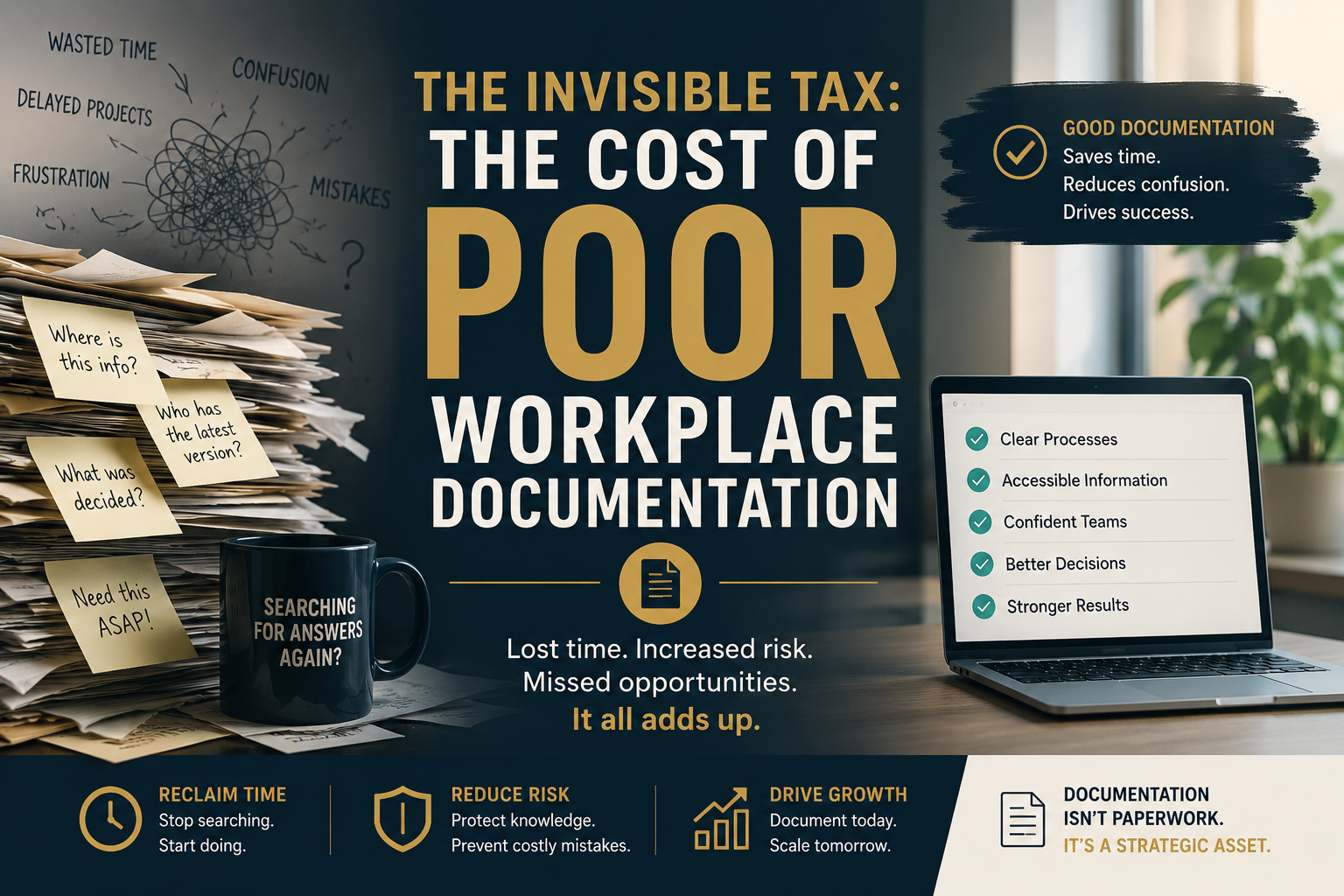
The Cost of Poor Workplace Documentation (And How to Fix It)
Every organization has expenses that appear on a financial statement. Salaries. Software licenses. Equipment. Office space.
But there’s another cost that rarely shows up on a budget report—a hidden expense that quietly drains productivity, delays projects, frustrates employees, and slows growth.
I call it Documentation Debt.
Documentation Debt is the accumulation of missing, outdated, incomplete, or poorly organized workplace documentation. Like financial debt, the longer it’s ignored, the more expensive it becomes. Every undocumented process, missing decision, outdated procedure, or forgotten lesson adds interest that your organization pays every single day.
While businesses invest millions in technology, cybersecurity, automation, and analytics, many overlook the one asset that makes all of those investments work effectively: clear, accessible workplace documentation.
The result is an invisible tax on productivity that affects every department.
Documentation Debt in Action
Throughout my career supporting engineering organizations, I’ve seen talented professionals lose valuable hours—not because they lacked the technical expertise to solve a problem, but because they couldn’t find the information they needed.
A project stalls because no one documented why a design decision was made six months ago.
A new employee spends weeks piecing together a release process because every experienced teammate explains it differently.
An engineer recreates work that already exists because no one knew where the original documentation was stored.
These situations are rarely dramatic. They’re simply repeated thousands of times across an organization until they become accepted as “the way things are.”
If you’re looking for practical ways to organize critical business knowledge, explore my Workplace Documentation Templates, designed to help teams capture information consistently and reduce confusion before it becomes costly.
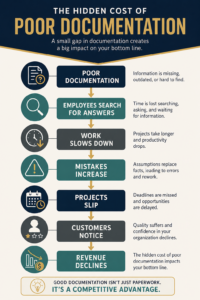 The Hidden Anatomy of Lost Time
Poor workplace documentation creates a constant cycle of interruption.
Instead of focusing on meaningful work, employees become detectives—searching emails, digging through shared drives, reading outdated documents, or tracking down coworkers for answers.
Research consistently shows that knowledge workers spend a significant portion of their workweek simply searching for information rather than using it.
Now consider the math.
Imagine a department of 40 professionals.
If each person loses just two hours every week searching for information or recreating undocumented processes:
- 80 hours are lost every week.
- More than 4,100 hours disappear every year.
- At an average fully loaded labor cost of $60 per hour, that’s nearly $250,000 annually in lost productivity.
And that’s before considering delayed projects, customer impacts, overtime, or employee frustration.
Poor documentation isn’t merely inefficient.
It’s expensive.
The Cost of Confusion
Documentation problems rarely exist in isolation.
Instead, they create a ripple effect throughout the organization.
One undocumented process leads to:
- Employees asking the same questions repeatedly.
- Work being duplicated.
- Mistakes requiring rework.
- Delayed approvals.
- Inconsistent customer experiences.
- Longer onboarding periods.
- Increased dependency on a handful of experienced employees.
I refer to this as The Cost of Confusion.
When people can’t find reliable information, they substitute assumptions.
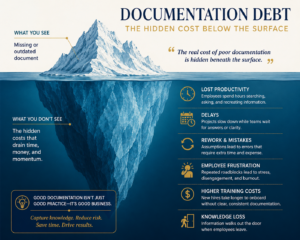 Assumptions almost always cost more than documentation.
One of the simplest ways to reduce confusion is by documenting meetings while decisions are still fresh. My Meeting Notes Template provides a structured way to capture action items, decisions, and follow-up tasks so important information doesn’t disappear into email threads or memory.
The Risk of Institutional Amnesia
Every organization has employees who “just know how things work.”
They know which reports matter.
Which systems require special steps.
Which customers have unique requirements.
Which process exceptions aren’t written anywhere.
They’re incredibly valuable.
They’re also one resignation, retirement, promotion, or vacation away from taking years of organizational knowledge with them.
Without effective knowledge management and process documentation, businesses suffer from institutional amnesia.
The replacement employee isn’t simply learning a new job.
They’re reconstructing years of undocumented decisions through trial and error.
That reconstruction costs time.
It increases risk.
And it often results in avoidable mistakes that could have been prevented with a well-maintained documentation system.
Why Documentation Drives Growth
Many organizations treat documentation as administrative work.
The most successful organizations treat it as infrastructure.
You can’t consistently improve a process that isn’t documented.
You can’t automate inconsistent work.
You can’t effectively train new employees without standardized procedures.
And you certainly can’t scale an organization if every team performs the same task differently.
Clear business process documentation creates repeatability.
Repeatability creates consistency.
Consistency creates quality.
Quality creates growth.
Documentation isn’t the enemy of innovation.
It’s what makes innovation sustainable.
Conduct a Five-Minute Documentation Audit
Ask yourself these questions:
- Could someone perform your most important process without asking another employee for help?
- Are major project decisions documented where the entire team can find them?
- Are your standard operating procedures current?
- Would a new employee know where to locate the latest version of a document?
- If your most experienced employee resigned tomorrow, would the organization continue operating smoothly?
If you answered “no” to any of these questions, your organization has begun accumulating Documentation Debt.
The good news is that documentation debt is entirely preventable.
Documentation Is a Strategic Asset
The solution isn’t creating more documents.
The solution is creating the right documentation, in the right place, at the right time, so the right people can quickly find and use it.
When organizations invest in better workplace documentation, they don’t simply create files.
They reduce confusion.
They improve onboarding.
They preserve institutional knowledge.
They shorten project timelines.
They reduce costly mistakes.
They enable continuous improvement.
Most importantly, they give employees back something they’ll never recover otherwise:
Time.
If you’re managing projects, documenting progress is just as important as planning the work itself. My Project Planning Kit helps teams organize project goals, timelines, risks, and deliverables, while the Incident Tracker makes it easier to document problems, resolutions, and lessons learned to prevent recurring issues. For professionals who want to keep an accurate record of accomplishments, coaching conversations, and workplace events, the Performance Log Template provides an easy way to build a documented history throughout the year.
At MindyEekhoff.com, I believe documentation should empower people—not burden them. That’s why I create practical frameworks, templates, and tools that help professionals capture knowledge before it becomes tribal knowledge and transform scattered information into organized, actionable systems. You’ll also find a growing collection of Strategic Thinking articles focused on improving decision-making, problem-solving, and workplace effectiveness.
If you’re ready to reduce Documentation Debt and build a more resilient, efficient workplace, download my Free Workplace Documentation Toolkit. It includes practical templates you can begin using immediately to improve documentation, preserve organizational knowledge, and build systems your team will actually use—because the cost of poor documentation is far greater than most organizations realize.